Risk management
How to understand and manage the cyber security risks for your organisation.
Page 13 of 15
Using attack trees to understand cyber security risk

How conceptual 'attack tree' diagrams can help you to represent and understand cyber security risk.
Introduction
This section introduces attack trees as a method for representing and understanding cyber security risk. Attack trees aim to build a structured and logical image of the cyber security risk to a system from the perspective of possible successful attacks.
What are attack trees ?
Attack trees are conceptual diagrams that show the variety of ways in which something can go wrong, and the reason why they might go wrong. The approach uses a visual representation of interconnected issues, that lead to a single major fault, and as such they are an effective way of performing root cause analysis. They are an adaption of the fault tree method used in safety analysis, an example of which is shown below.
In applying the same logic to cyber security, you can investigate the different ways that a system might be attacked, or how an attacker might achieve a specific objective.
Attack trees use a hierarchical representation of the steps needed for a successful attack. Each of the steps gives a requirement for completion for the step linked above it, where a successful attack is a complete set of requirements from the nodes at the bottom of the tree to those at the top. Each path in the tree should be unique, and there should be no loops in the design.

Why use an attack tree ?
Attack trees can provide another way of understanding cyber security risk by providing a visualisation of the problem. By diagrammatically representing a core concern and the components that lead to the attack, you can:
- Develop an understanding of how something can be at risk, noting not just the breadth of attack methods, but the number and ease of steps that are required.
- Develop a useful discussion tool. The simple design of a tree encourages discussions, critiques, and quick understanding of the attack methods used.
Visualising cyber security risk in this way gives a clear understanding of where the risk comes from, allowing you to identify security weaknesses and develop mitigations for them.
Attack trees can also be used effectively in agile environments, where the tree can be built alongside iterative development. Taking this approach means that cyber security risks are considered as they are discovered, and appropriate countermeasures can be introduced.
How to build attack trees
An attack tree is built from two components, nodes and branches.
Nodes can be representative of any aspect of an attack. This is usually an action from an attacker ('steal password') or a state that the system reaches as a result of an action ('get access to password manager').
Branches represent the dependencies between the nodes, identifying a causal link between the completion of those nodes that are lower in the tree with those above them. In most attack trees, no contextual information is given to a branch in a tree when represented diagrammatically. Any context is held implicitly between the two nodes.
To start building an attack tree, the first thing to consider is the objective of an attacker, or your overarching security concerns. These concerns should be sufficiently broad to acknowledge that attackers will usually be able to take multiple approaches to achieve their objective. This could range from broad concerns such as 'Can authentication of employees be bypassed?' to narrower questions like 'How vulnerable is my firewall configuration?' Once identified, this is placed at the top of the tree (also known as the root node).

Bypass Authentication
The next step is to identify as many ways by which that end goal or core concern can be realised. This can be defined in a variety of different ways, but is frequently represented as a set of technical capabilities required by the attacker. You can also consider the targets (different end points at which the objectives can be achieved) or vectors (the means by which the objectives can be achieved).
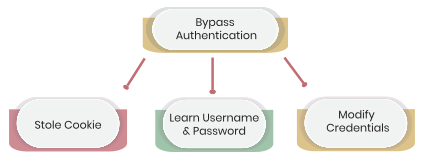
This step should then be repeated for each new node created, until there are no further steps in the process. The final nodes (that is, nodes with no steps beneath them) are known as leaf nodes.
When building an attack tree, there's no need to worry about aesthetics (that is, whether or not it looks like a tree). There's no need to have the same number of branches from each node, or for all paths from leaf nodes to the root node to be the same length. In fact, your tree will most likely be asymmetrical since attacks may have different numbers of steps, or require more or less detail.
Below is an example of how to build an attack tree based on a JavaScript example by Gergely Nemeth.
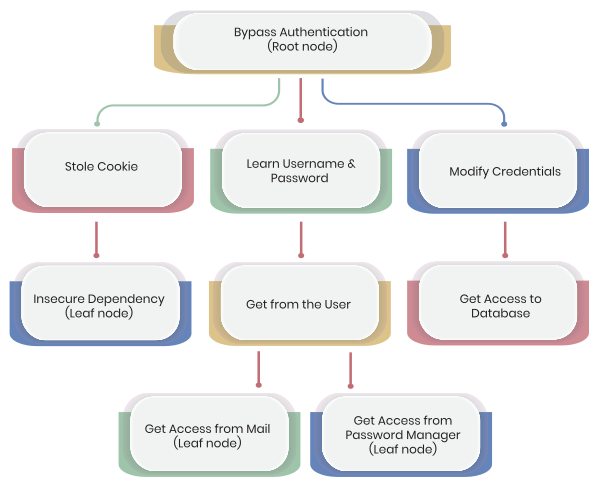
You should document each step of the attack tree build to capture the justification and evidence base used for making key decisions. It will also act as an audit trail, providing a rationale for decisions made based on the assessment.
If a larger attack tree is being built over a long period, the tree should be reviewed by a subject-matter expert to ensure that any assumptions made when the tree was originally built are still relevant. Nodes should be updated, as appropriate.
Building attack trees: a summary
- Identify the core issue.
- Create the root node for the core issue.
- Identify the steps by which the attacker can achieve the core issue.
- Add these steps as nodes beneath the core issue.
- Repeat the process for each of the nodes you've just added.
- The tree is complete when each branch of the tree ends in a leaf node (that is, nodes with no steps beneath them).
How do you work with attack trees ?
While the above process defines how a tree can be constructed conceptually, it doesn’t capture where the cyber security risk lies within the system. At this stage, the diagram only represents the different stages of an attack that come together to achieve a desired end goal. The next stage is to evaluate the tree. This is a process where the representation of the problem is turned into an assessment of the associated cyber security risk.
A practical example of the use of attack trees
You may find it useful to review how the NCSC used attack trees to identify cyber security risks in our security analysis for the UK telecoms sector. This involved identifying higher level impacts or outcomes, and linking these to lower level methods or exploitation routes that could contribute to such events occurring.
Further reading
Further useful reading on attack trees can be seen in work by Bruce Schneier.