Distributed ledger technology
The nature and applications of distributed ledger technology
Introduction
The popularity of blockchain-based cryptocurrencies like Bitcoin has raised the profile of distributed ledger technology.
A distributed ledger is a type of append-only data storage mechanism that can provide high levels of transparency, integrity and availability in a decentralised environment. Sometimes, however, a distributed ledger is used where a more traditional solution might be cheaper, simpler or more secure.
This white paper sets out the NCSC position on distributed ledger technology. The goal is to aid decision-makers in determining whether use of a distributed ledger is appropriate.
Distributed ledger technology
A distributed ledger is an append-only data storage mechanism in which data is stored at multiple locations on a shared network.
A distributed ledger will often store data in the form of a blockchain, a type of data structure consisting of blocks of data with a strict sequential ordering, but not all distributed ledgers use a blockchain as their underlying data structure.
A distributed ledger may be permissioned or permissionless. A permissioned distributed ledger may be public or private. Definitions of these terms can be found in the glossary at the end of this document.
A distributed ledger can provide transparency, integrity and availability in a decentralised environment where there is no trusted central authority. However, distributed ledgers are also relatively expensive to build and maintain, can struggle to provide privacy, and can suffer from poor transaction throughput and high latency.
Due to the common use of energy-intensive consensus mechanisms - required in order to maintain consistent copies of the ledger across different storage locations - distributed ledger technology can also have a negative environmental impact. Furthermore, the security of distributed ledger technology has not been extensively studied. Poor use of cryptography, or poor implementation, can compromise the security of a distributed ledger.
Determining the suitability of distributed ledger technology
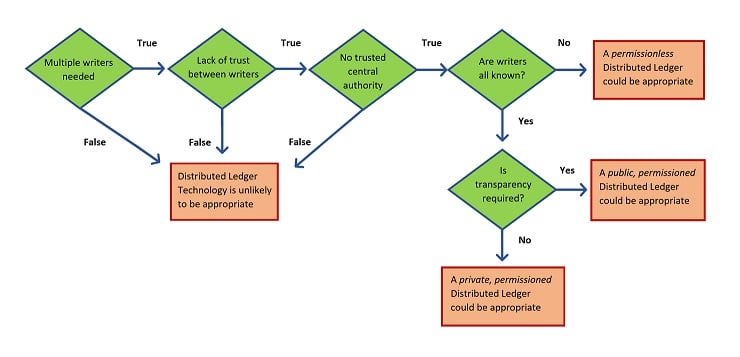
A distributed ledger might be an appropriate data storage solution if all of the following statements are true:
- Multiple entities need to be able to write data
- There is a lack of trust between the entities writing data
- There is no trusted central authority that can write data on behalf of the entities
Otherwise, a conventional technology like a database is likely to be more appropriate.
The flowchart below can be used alongside the list above as a tool to help determine whether a distributed ledger is an appropriate data storage solution, and if so, what type might be appropriate.
Example applications
Cryptocurrencies like Bitcoin provide an example of when using a permissionless distributed ledger can add value.
A cryptocurrency typically operates in an environment where there is a large and dynamic collection of users who do not trust one another and do not desire oversight from a trusted central authority. A permissionless distributed ledger can provide transactions with the required levels of transparency, integrity and availability.
The examples below look at other situations in which a distributed ledger might be proposed as the solution to a problem, and consider whether or not the use of a distributed ledger is appropriate.
Example: Trade of digital artwork
You wish to set up a platform for users, who don’t completely trust one another, to trade digital artwork. The platform must store information about the creation and sale of the artwork, and provide proof of ownership without storing personal information.
Because the assets are digital, they can be tied directly to the ledger, for example by storing a hash of the asset on the ledger. This means there is no need for a trusted third party to mediate disputes, so a public permissionless ledger might be appropriate.
Example: Attestation
You wish to set up a virtual notary service. You require a system to store attested documents and allow certain entities access for verification. There is no implicit trust between the entities involved, nor a central trusted notary that can write data on behalf of the entities.
In this case, a private permissioned ledger storing document hashes and timestamps might be appropriate, preventing tamper and providing proof of what was signed when, to those needing to verify this information.
Example: Supply chain management
You are involved in the supply chain management of a food product, the provenance of which is important to your customers. You want a reliable and tamper-proof record of the origin of the product, and transit information relating to the product as it passes through the supply chain.
Here, a public permissioned ledger might be appropriate. However, since the product exists outside of the ledger environment, the correctness of data in the ledger is not guaranteed, and added value is therefore limited.
Example: Storing customer data
You wish to store customer data in a distributed ledger. Here, transactions consist of adding, removing and updating personal data records.
As you are the only one wishing to add data, a distributed ledger gives few benefits over a conventional database. Furthermore, once data has been added to a distributed ledger, it cannot be altered or removed. While technical solutions have been proposed to address the issue of how to fulfil a request for removal of personal data from a distributed ledger, these are relatively unexplored.
Alternative technologies
A distributed ledger can be a reasonable way to record and store information when there is no trust between users. For applications where trust is implicit between parties, the gains are small compared to the costs of ledger maintenance, and alternative technologies should be considered.
A comparison between the properties of distributed ledgers and databases is provided in Table 1. Definitions of many of the terms used in Table 1 can be found in the glossary at the end of this document.
| Permissionless distributed ledger | Permissioned distributed ledger | Distributed database | Traditional database |
|---|---|---|---|
| No trust required between writers | Require either trust between all writers or a trusted central authority | ||
| Implicitly tamper-proof | Additional mechanisms/procedures required for tamper-proofing | ||
| Decentralised | Somewhat decentralised | Centralised | |
| Transparent | Transparency as required | Limited transparency | |
| High levels of availability | Single storage location can cause availability issues | ||
| Low throughput and difficult to scale | Moderate throughput and scalability | High throughput and good scalability | |
| Expensive to build and maintain | Moderately expensive to build and maintain | Inexpensive to build and maintain | |
Table 1: Properties of distributed ledgers and more conventional technologies
Future direction
As adoption of distributed ledger technology becomes more widespread, issues of scalability, privacy and environmental impact must be addressed.
The technology faces some uncertainty. For example, the legal positions of applications such as smart contracts and digital assets are being explored by institutions including the UK’s Law Commission [1].
In the UK, the Information Commissioner’s Office supports research into the data protection implications of emerging technologies such as distributed ledger technology, including how it might be used in a manner compliant with GDPR to enhance privacy and accountability [2]. It is unclear, however, if such research has been undertaken.
The overwhelming majority of distributed ledgers employ digital signatures for authentication and for ensuring integrity of data. These may be vulnerable to attack by a possible future quantum computer. Guidance on this topic can be found in the NCSC White Paper on Preparing for Quantum-Safe Cryptography [3].
NCSC position on distributed ledger technology
A close examination of many proposed uses of distributed ledgers reveal that the technology typically offers little or no benefit in terms of cost, performance or security over alternative technologies.
Distributed ledgers can offer a technical solution in certain scenarios, such as in decentralised environments where there is no trusted central authority.
However, distributed ledgers can carry hidden costs, financially, computationally and environmentally, and they often suffer from poor scalability.
Further developments may bring additional benefits to distributed ledger solutions but, for now, there are alternative technologies which usually provide comparable, or better, solutions.
Glossary
Availability The property of a data storage system that ensures data can be accessed when required.
Blockchain A data structure consisting of blocks of data that are linked using cryptographic mechanisms that provide tamper-proofing. Typically used as the underlying data structure of a distributed ledger.
Centralisation The property of a data storage system whereby a minority of participants, or a trusted authority, determines what data is added to the system.
Cryptocurrency A digital currency in which cryptography is used to regulate the generation of units of currency and verify the transfer of funds, operating independently of a central bank.
Decentralisation The property of a data storage system whereby any participant has influence over what data is added to the data structure.
Distributed ledger A data storage mechanism in which data is stored at multiple locations on a shared network.
Integrity The property of a data storage system that ensures both accidental and deliberate modification of data can be detected.
Latency The delay between when data is proposed to be added to a distributed ledger and when the data is actually added.
Permissioned distributed ledger A distributed ledger where a central authority is responsible for controlling read and write permissions of users of the ledger. A permissioned distributed ledger may be private or public.
Permissionless distributed ledger A distributed ledger in which any entity may read or write to the ledger.
Privacy The property of a data storage system that ensures information that is intended to remain private does so.
Private distributed ledger A distributed ledger in which transactions are only visible to those with read permissions.
Public distributed ledger A distributed ledger in which all transactions are publicly visible.
Tamper-proof The property of a data storage system whereby the data contained cannot be modified without detection.
Transaction throughput The rate at which data can be added to a distributed ledger.
Transparency The property of a data storage system whereby all stored data is publicly accessible. Note that encryption of data does not prevent transparency, providing the encrypted data is publicly accessible.